Participants:
| (DOE) | Dove |
| (UCSD) | Mau, Miller, Najmabadi, Raffray, Tillack, Wang |
| (PPPL) | Jardin |
| (GA) | * |
| (UW) | El-Guebaly, Sviatoslavsky |
| (FPA) | * |
| (RPI) | Steiner |
| (ANL) | Billone, Sze |
| (Boeing) | Waganer |
| (INEEL) | * |
| (MIT) | Bromberg |
Snowmass - Farrokh emphasized that we need to have a strong technical impact at Snowmass, both at the meeting and preceding it. The Snowmass meeting is not intended to be a presentation style meeting; rather it is a workshop format. As such, it is important to provide the session and discussion leaders with technical data to stimulate and substantiate discussion.
Les Waganer reported that he has just begun to examine the product options proposed for the neutron source. The listing he presented to the ARIES team last yeargenerally encompasses the products and concepts identified to date. The next action is to collect detailed information and technical data on the selected concepts/products.
Don Steiner discussed the interaction between fusion, fission, and accelerator communities to provide a source of neutrons for transmutation or energy production. Don mentioned the PLATO project being sponsored by Curt Bolton.
Ron Miller reviewed the need to have appropriate metrics to provide a meaningful evaluation of the alternate neutron sources being considered. Since this aspect is common to the PLATO project, he will be collaborating with that project.
Mark Tillack is to compile and assess the engineering and nuclear performance of the proposed concepts. He is planning to use the metrics identified by Ron to measure the performance. The support ratio of number of LWRs may be a good measure. Mark was concerned about the bulk of the technical information regarding these approaches. Don Steiner said he would help Mark review and categorize the information as he felt there was a lot of commonality.
Dave Petti is responsible for the environmental, safety, and licensing implications of the fusion neutron source applications, especially the plutonium disposition and radioactive waste transmutation. Dave was not on the call.
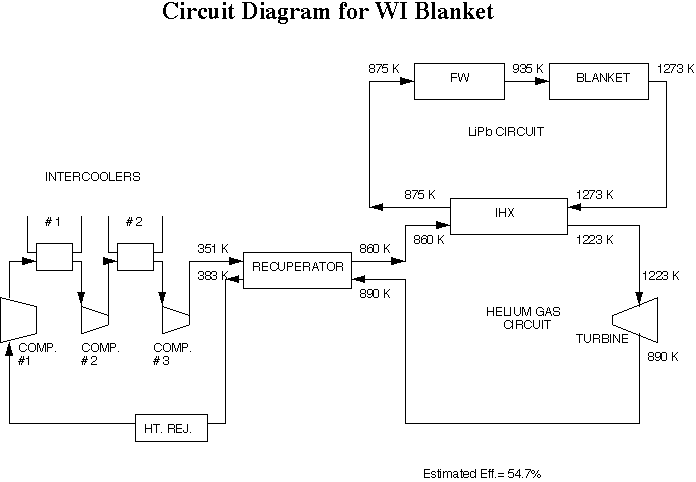
Igor Sviatoslavsky showed a new power flow diagram for the self-cooled LiPb/SiC design with an increased temperature in the primary (1000°C LiPb) and secondary loops (950°C He) (see figure). These changes yielded an estimated thermal conversion efficiency of 54.7%. The flow rate of the LiPb was also increased from 1.2 m/s to 3.1 m/s. The recommended LiPb outlet coolant temperature is higher than the ARIES-ST design, which was 700°C. There was concern that there has been no data to indicate compatibly of LiPb with SiC at this temperature range. Impurity in the SiC fibers, especially oxygen, is very detrimental to the compatibility of the coolant and the structure. Since it is crucial to have a high coolant temperature, we should proceed with the chosen materials and operating temperatures. However, we must explicitly highlight the need to have confirming material compatibility testing.
It was suggested that Ron Miller conduct a COE trade study to determine the impact of the outlet blanket coolant temperature and resultant thermal cycle efficiency. ReneRaffray has also determined coolant temperatures and cycle efficiencies. Rene and Igor should collaborate on their analyses and determine a common configuration, thermal conditions, and system efficiency for use in the engineering design and system code analyses.
Rene Raffray noted that two design approaches for SiC/LiPb blankets were presented at the Madison meeting by UCSD and UW, respectively. The parameters will include the latest SiC properties recommended by Mike Billone. A common set of input parameters is being evolved with input from UW, ANL and UCSD so that the design and analysis of each option can be done on a consistent technical basis. Rene stated that the first wall and blanket material composition by zone for the LiPb/SiC/He blanket will be sent shortly to Laila for the neutronic analysis of this concept. He also agreed to coordinate with Igor in using a consistent Brayton cycle analysis procedure.
Dai-Kai Sze just returned from Japan and had no new input on the use of LiSn breeder and coolant design approach.
Mike Billone reported that he has been working on obtaining SiC mechanical and thermal properties to use as design properties. To be valid, the data must be tested after irradiation and within the operating temperature range. One SiC material is thought to have excellent properties, but Mike wants to make sure the data is valid before releasing the data for use. He also stressed that the lifetime of SiC should be determined by a burn-up fraction of 3%, not a certain dpa value.
Leslie Bromberg attended a High Temperature Superconductor (HTS) workshop at ANL, which addressed the performance and costing of HTS. The production installed cost of $200/kg for HTS conductors is considered to be the minimum attainable. Leslie is collaborating with ORNL and PPPL to develop a set of preliminary design criteria. These data will be discussed at Snowmass. There are three options to be evaluated:
It was suggested that Leslie Bromberg work with Les Waganer to determine if the cost of magnet structures could be significantly reduced with innovative fabrication techniques.
Les Waganer reported on the kickoff meeting of the Large Fusion Power Plant study being directed by John Sheffield of ORNL. Duke Engineering and TVA are responsible to determine the impact of integrating a large electric plant (3-5 GWe) into their electric grid. Their major concern was the loss of planned and unplanned outages of that magnitude. Even though these are relatively large utilities, they still envision they would have to substantially increase their reserve capacity. They would rather pay for unused excess capacity than pay extremely high spot prices to cover peak demands due to forced outages. Joan Ogden of Princeton University is responsible for the hydrogen product and marketing strategy. She believes that hydrogen produced by off-peak, surplus electricity can be a profit-making venture. TVA currently uses pumped storage to help level its peak and surplus electricity. The best approach for making hydrogen seems to be the high temperature electrolysis process with desired temperatures above 800°C. Les Waganer is reviewing the best product for the large fusion facility. He is also responsible for the engineering aspects of the fusion plant and integrating it with the hydrogen production facility.