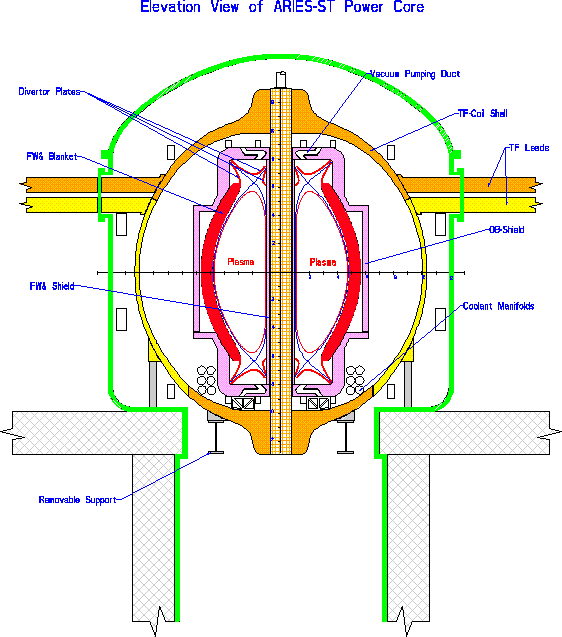
The inboard shield has once-through cooling, and therefore the coolant should be routed from top to bottom through the blanket/shield. Since the coolant will be hot and the shield cold, it was decided best to route it behind the blanket as part of the hot structures.
The coolant path from the top of the centerpost is a special case, and probably will not be routed back to the bottom, since it's outside the vacuum boundary. Since it was agreed to try use the TF shell as the VV, all joints and breaks in the TF system must be covered by bellows of some kind, TBD.
Dai-Kai Sze mentioned that the lithium-lead flow is a once-through approach (Mark noted after the call that the PbLi coolant comes in the bottom, turns at the top and then comes out the bottom, which would correspond to twice through. D-K Sze has started on a inboard shield flow arrangement for the helium coolant systems, which will be provided to M. Tillack. Dai-Kai thought it would not be a problem to locally reroute the helium and LiPb coolants around the heating and current drive components in the outboard region. Dai-Kai also agreed to consider modifying the blanket geometry away from modular construction and toward single-piece construction.
Mark referenced the drawing which placed the vacuum vessel outside the PF coils, but Wayne Reisersen noted that at the January meeting, the group had decided to place the vacuum vessel inside spherical TF coil legs. The group discussed whether or not the TF shell could serve as a vacuum vessel since it must have breaks. Wayne said that, based on his discussions with Charlie Neumeyer, they felt the TF shell would not need slits, and that bellows could be used at breaks to provide leak-tight vacuum. So it was affirmed that the vacuum boundary would be just inside the TF outer coil legs.
The position of the upper and lower two PF coils is not finalized yet. Locating them either inside or outside the TF coils is being considered. The innermost one would be difficult to locate outside because of the thickness of the TF coils near the centerpost. Therefore, the TF coil configuration should be established and then the location of the PF coils will be evaluated. The thickness of the upper TF shell may approach a meter.
The position of the TF coil leads was discussed. The position shown in the current elevation view is just above the midplane. E. Mogahed suggested moving them closer to the centerpost. However, a connection near the centerpost is in the thickest TF coil cross-section which would make it difficult to make the connection. Moving the lead connections to the bottom would place them in the maintenance area, which would be undesirable. Therefore it was decided to keep them close to where they are currently shown.
The vacuum pumping ducts are located at the top of the machine, provided there is adequate vacuum conductance from the vacuum port at the bottom of the machine. The vacuum pumps would be located close to the device at the upper level.
Ron also included a table on the web site which listed results regarding the straight versus flared centerpost with different filling fractions.