Participants: Administrative
The next ARIES conference call is scheduled for February 9
from 9-12 PST with a call in number of 314-232-7532.
Laila El-Guebaly informed the team that Igor Sviatoslavsky
was doing well after his surgery. The entire team wishes for his speedy
recovery.
Farrokh Najmabadi explained that plans for the March meeting
are being changed. The date for the US/Japan Reactor Design Workshop (3 days)
to be held in San Diego has been moved to the March time frame. Thus it might
be more convenient to hold the ARIES meeting (2 days) at the same time in San
Diego. Also, the IAE Socio-Economic Task results might be reported at this
same meeting. Most of the ARIES team had no conflicts during March except for
the HI Inertial Fusion Symposium the week 13-17 March. So Farrokh is planning
to coordinate the best time for all the participants of the two meetings and
inform the team of the proposed dates.
At the December meeting, it was suggested that UW host the
June meeting. Laila has arranged for a meeting room during the week of 26-30
June. This would be convenient to involve UW people who are involved in IFE
work. On the other hand, we also are anxious to begin a closer exchange with
the PPPL FIRE team.
C. Baker noted that the guidelines for consideration of
innovative technical proposals can be found on the VLT web site.
Neutron Source Study
C. Baker mentioned that Bill Stacey is scheduled to address
FESAC early in February on the subject of "burning" nuclear waste in
accelerator, fission, and fusion systems. Charlie suggested that Don Steiner
contact Bill to inform him of the most current ARIES Neutron Source Study
results.
Don Steiner mentioned that section drafts have been received
from L. Waganer, D. Petti, M. Tillack, and R. Miller. Don is hopeful that
Ed Cheng can provide additional material to be added to Mark's engineering
performance and neutronics assessment section - Mark will check with Ed again.
Ron Miller wants to rerun two cases to provide a more realistic assessment.
Don hoped that all of the draft material could be provided to F. Najmabadi in
two weeks.
Don commented on the ATW report to Congress. The main
thrust of the report was to reduce the stockpiles of excess weapons grade Pu,
not to address spent fuel waste. The estimated cost to develop the ATW was
quoted to be $10B. He also mentioned that the ATW report did not try to
compare the ATW with any other alternative options, rather it recommended
funding ATW on its own merits. Don also noted that many of the ATW technical
issues are similar to those identified for a fusion system. Dave Petti
commented that, although the issues seem to be similar, there are some
significant differences in the lower level details. Also, the accelerator
system is likely to have a more adaptable target system than a fusion system.
Dave noted that accelerator technology is better developed than fusion. Don
stated that fusion offers significantly more potential in other
applications.
Mark remarked that he had substantially modified his
assessment section and it is posted on the ARIES web
site, but he has had little feedback. Additional fission data from MIT and
an aqueous concept from LANL were added.
Dave Petti briefly discussed the differences between a
subcritical assembly in a fission reactor as compared to a fusion core. Lead
bismuth-cooled systems can yield a system with a positive temperature
coefficient, but not lead to critical events. The MIT group looked at LOCA
events in this system. Dave mentioned that fission waste reduction systems
would be very reliable.
Ron Miller mentioned that he had circulated a section draft
and system code results in December, but these need to be updated to address
high K
(DOE)
(UCSD) Baker, Mau, Miller, Najmabadi, Raffray,
Tillack, Wang
(PPPL) Kessel, T. Brown, Heitzenroeder, Dahlgren
(GA)
(UW) El-Guebaly, Mogahed
(FPA) Dean
(RPI) Steiner
(ANL) Sze
(Boeing)Waganer
(INEEL)Petti
(MIT)
The remainder of the conference call addressed the pending action item results. [Generally, only the pending action items are shown.] See the 1-3 December meeting minutes for the complete list of Action Items.
Systems Analyses
|
Miller |
ASAP |
Verify coolant mass and component volumes in ASC with CAD and neutronic data |
|
Miller |
ASAP |
Incorporate new radial build and nuclear parameters from El-Guebaly |
|
Miller |
ASAP |
Incorporate new heating and CD power requirement scaling from Mau |
|
Miller |
Jan 14 |
Complete new optimum strawman with parametric results |
Ron Miller stated that the verification of the component and coolant volumes and masses is in work. He has received the new radial build from Laila El-Guebaly and the data has been incorporated. He needs the new heating and CD power algorithms from TK Mau, which are not available yet. During the call, Ron said he could start to use the lower edge density modeling. TK agreed to send Ron the modeling immediately, with the remaining algorithms to be delivered within a week. Ron was to have the new strawman done by 14 Jan, but the slow input of data has delayed the strawman by a week or two.
Configuration and Maintenance
|
Tillack/Wang |
Jan 14 |
Preliminary definition of integrated power core geometry and maintenance approach |
Mark Tillack said that all his analysis was conducted considering the new Siegfried Malang blanket fabrication approach of two nested SiC/SiC shells. There were two assembly and maintenance approaches. One involved using smaller access ports with removal of small components through the ports. This would entail a highly reliable method to break and make coolant and mechanical joints inside the vacuum boundary. If the joints are to be outside the vacuum boundary, the maintenance approach is closer to the concept of removal of a complete sector through a large opening in the vacuum vessel, followed by transport to the hot cell (ala ARIES-RS). Mark mentioned a third concept with a complete sector through the large opening but all maintenance would be accomplished just outside the vacuum vessel. The assessment is not complete yet.
Phil Heitzenroeder and Tom Brown asked to obtain a CAD file to assess component clearances in a solid model. Xueren Wang noted that the preliminary CAD file of the AT power core is only a 2-D model and would not represent the upcoming strawman. There was discussion as to the merits of a CAD clearance assessment prior to a firm strawman. Tentatively, it was agreed to allocate a small effort to determine the TF coil position suitable for module extraction. However, there should be frequent communication between PPPL and UCSD to retain a coordinated design basis and efficient use of resources.
In addition to the TF coil shape and location, the location and sizes of the PF coils are needed. C. Kessel agreed to provide location, size, and currents in the PF coils to R. Miller. If they cannot be placed above/below the vacuum vessel door parting line, they will probably have to be capable of being moved vertically for maintenance actions.
Neutronics and Shielding
|
El-Guebaly |
Jan 30 |
Update nuclear parameters for new reference blanket design |
|
El-Guebaly |
Jan10 |
Update coolant requirements for HT and LT shields |
|
El-Guebaly |
Jan 10 |
Assess impact of Al vertical stabilizing shell on TBR and enrichment |
|
El-Guebaly |
Jan 10 |
Determine thickness of LT shield with increased water content in vacuum vessel |
Laila is using a 10% water fraction for all the shields in the nuclear analyses of the power core components. She has evaluated the three candidate vertical shell conductor materials (W, Al, and Cu) and has determined that a blanket without stabilizing shells would yield an overall breeding ratio of 1.15. Al has the least impact on breeding followed by Cu and then W. The thickness of the shell depends on the type of conductor, operating temperature, and time constant. Further analysis is needed to optimize those parameters. The blanket and/or enrichment will then be optimized to yield the required breeding ratio of 1.1. Rather than using nearly pure W, it was suggested that tungsten alloy might be substituted if the alloying elements are acceptable. There was a discussion about where to mount the shell and its operating temperature.
Laila has provided a new radial build to Ron Miller for input to the systems code.
Heating and Current Drive
No pending action items. But Mark Tillack inquired about the materials to be considered in the RF antenna or launchers. It was recognized the material must be highly conductive. Must it be copper (operated cold) or could it be SiC covered with tungsten (operated hot)? TK is to work with designers to establish conductivity and geometry requirements.
PF and TF Magnets
|
Tillack/ Bromberg |
Dec 10 |
Obtain data from Bromberg including detail substantiation of magnet cost estimate plus magnet shape, cross-section, and required structure |
|
Bromberg |
Jan 1 |
Expand parameter space of J-B to include temperature and conduct a trade study of NbTi, Nb3Sn, and HTS magnets in the 8-10 T range |
Mark Tillack and Ron Miller discussed the need to obtain more detailed substantiation of the magnet component costs and the engineering characteristics to be input into the ARIES code. It seemed as though no firm data has been obtained from Bromberg. The structural requirements are still needed. This is especially true if the designs push to higher field strength, high temperature magnets.
Vacuum Vessel
|
Miller |
Jan 1 |
Determine the ARIES-RS vacuum vessel weight and cost |
|
Tillack/Wang |
Jan 14 |
Define integrated geometry |
Ron Miller reported that he send Les Waganer vacuum vessel mass and cost data in December.
Mark remarked that the preliminary assessment of the power core tends to suggest a vacuum vessel similar to that of ARIES-RS.
Fuel Cycle System and Main Heat Transfer and Transport System
|
Sze |
Jan 14 |
Define approaches and parameters for reference fuel cycle |
|
Sze |
Jan 30 |
Develop preliminary design for IHX and material selection |
Dai Kai Sze is continuing to define the reference fuel cycle system elements. On the IHX, he is assuming the primary side will be SiC, with a super alloy on the secondary side; but he has not yet decided on the location and method of the material transition.
Vertical Stabilizing Shell
No pending action items. Laila presented Igor Sviatoslavsky's comparison of tungsten and TZM as cladding materials. The electrical resistivity of solid W and solid and liquid Al and Cu were presented. The higher melting temperature and the lower resistivity of copper were the major reasons for selecting copper with a tungsten coating.
Activation
|
El-Guebaly/ Wilson |
Jan 10 |
Add Class A NRC limits to ALARA code |
Laila reported that the Class A NRC limits have been added to the ALARA code. Laila asked to have data on the permeation of tritium into and out of SiC to help determine the ability to meet the Class A waste limits - Dai Kai will provide data to Laila.
Safety and Waste Management
No pending action items.
Materials
|
Sze |
Mar 6 |
Select permeation window for coolant loop (Nb?) |
|
El-Guebaly/ Zinkle/Miller/Sze |
Mar 6 |
Determine cost for Li enrichment - conduct tradeoff of enrichment versus thickness of blankets |
|
Raffray |
Jan 30 |
Determine feasibility of SiC braze and provide composition of brazing material to El-Guebaly |
|
El-Guebaly/ Henderson/Abdou |
Mar 20 |
Assess compatibility of brazing material with waste and activation requirements |
Dai Kai Sze is presently favoring a helium gas purge rather than a permeation window in the primary coolant system.
Dai Kai Sze contacted Steve Zinkle about the Li enrichment cost. Steve intends to talk to a few more experts and then give us a recommended cost estimate.
Rene Raffray is hoping to obtain definitive data on the SiC braze material and procedure at the ORNL SiC meeting in mid-January. He mentioned that a revised agenda is provided on the ARIES web site.
Blanket
|
Raffray |
Jan 1 |
Affirm feasibility of alternate blanket design approach (adopt if suitable) - coordinate preliminary design parameters to design leaders |
|
Raffray/ Tillack |
Jan 7 |
Determine maintenance approach is compatible with blanket |
Rene Raffray affirmed the adoption of the Siegfried Malang blanket design approach. He is currently trying to define and balance the pressure drop in the smaller and larger flow channels. Manifolding is expected to be a problem to design and fabricate. Rene is also trying to define the routing of the coolant through all power core components to satisfy all the design requirements.
The preliminary blanket design is thought to be compatible with the tentative assembly and maintenance scheme.
Divertor
|
Raffray |
Jan 7 |
Assess and select preliminary outboard divertor design approach (transverse, thin slot). Coordinate with UW and CAD design. Decide on SiC or W surface |
|
Raffray/Wang/ El-Guebaly/ Kessel |
Jan 10 |
Determine, assess, and select preliminary inboard strike plate design approach. Coordinate with CAD design regarding inboard vacuum pumping ports and with UW for breeding and activation requirements. Determine if strike plate will double as inboard vertical stabilizing shell. |
|
Sze/Raffray/ Tillack |
Jan 7 |
Determine (in conjunction with Molokov) pumping requirements and thermal heat transfer capability in a high velocity liquid metal within a magnetic field |
|
Kessel |
Jan 7 |
Solicit FIRE UEDGE data on shortened inboard divertor slot |
|
Tillack |
Jan 14 |
Obtain from Petrie data on power flows to inboard and outboard regions |
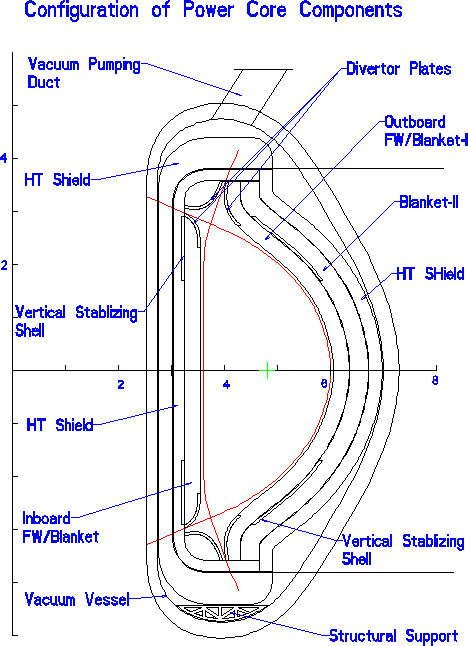
At the last meeting, it was thought that the increased elongation and triangularity of the AT plasma had eliminated the physical space for an inboard divertor. However, Mark Tillack examined the preliminary CAD drawing of the AT. A portion of that drawing, shown at the left, illustrates that there may be sufficient depth to allow a small slot divertor in this area. Laila offered to analyze the neutronics effects if a preliminary design were developed for the inboard divertor. She recommended any manifold be located away from this region.
Dai Kai Sze said that he has discussed with Rich Mattas the need to involve Molokov in the divertor MHD and inertial pumping power losses. He also asked Rich to provide a liquid metal surface divertor design for ARIES-AT.
The need to verify the outboard/inboard divertor transport power split was again discussed. Farrokh Najmabadi affirmed that such a power split had been demonstrated on DIII-D - we need to have a documented reference (Action: C. Kessel). Rene Raffray is seeking a firm peak heat flux on the divertor plates to devise and assess the divertor materials and design approaches. Farrokh suggested a nominal value of 5 MW/m2, pending a more detailed determination after the strawman and divertor surfaces are established.
Physics (PPPL)
|
Kessel |
Jan 10 |
Provide PF coil locations and currents for baseline plasma to ASC |
|
Kessel |
Jan 10 |
Refine material, position, thickness, and power requirements for vertical stabilizing inboard and outboard shells |
|
PPPL Support |
As req. |
Support tasks: * Provide plasma free boundary flux geometry * Provide to UCSD and GA finite edge density case with kappa = 2.2 * Provide UCSD with equilibrium data for systems code * Calculate strawman in JSOLVER and verify physics parameters * Analyze ripple for a number of TF field coils over a range of outer leg positions |
Chuck Kessel stated that he has compiled a complete set of free boundary equilibrium cases to help bound and optimize the plasma conditions. He can provide the plasma flux surfaces for input into the code and to help define the divertor and blanket surfaces (see ARIES web site for provided data.) He can provide the PF coil locations, sizes, and currents for the systems code. He has been working on the requirements of the vertical stabilizing inboard and outboard shells to stabilize the plasma, but needs more layout information on the blanket and shell design to finalize plasma response times with more realistic shells.
Chuck has completed three cases at higher elongation values, yielding beta
N values of 5.6, 6.0, and 6.8. These data will be provided to Ron Miller for the systems code.Physics (UCSD)
|
Mau |
Jan 10 |
Analyze RFCD capability with a finite edge density case, kappa = 2.2 |
|
Mau |
Jan 17 |
Investigate ECCD for on-axis and off-axis CD |
|
Mau |
Jan 17 |
Revise RF/NB system cost model based on ITER guidelines |
TK Mau is investigating the ability of RFCD to supplement BS currents in a plasma with a kappa of 2.2 over a range of edge plasma densities and temperatures. He will provide Ron Miller with some preliminary scaling immediately, following with the remainder within a week.
Physics (GAT)
|
Chan |
Jan 10 |
Look for self-consistent pressure, bootstrap, density, and rotation profiles giving stability results near optimal |
|
Chan |
Jan 17 |
Calculate rotation needed for stabilization of RWM and NB requirements |
|
Chan |
Jan 10 |
Perform power-balance exercise |
|
Chan |
Jan 10 |
Calculate UEDGE 2D solution for edge profiles |
No results were known from GAT physics work.