L.N.Topilski,
ITER Joint Central Team,
S.T. Polkinghorne and B.J. Merrill,
INEEL, Idaho,US
This paper summarizes analyses showing the integrity of the ITER first confinement barier to in-vessel loss of coolant events. Because of different possible failures of the heat transport system (HTS) pipes or coolant channels inside the vacuum vessel (VV), some amount of water coolant could be spilled inside the VV. These failures will result in a pressurization of the VV. The peak pressure and the pressure transient are functions of the water temperature and the break size. To prevent VV pressurization over the design limit 500 kPa, in case of big breaks, a pressure suppression system is incorporated ito the design.
The temperature of water coolant ranges from 140 C to 190 C for normal operation conditions and is about 240 C in case of baking. The smallest break size is estimated as 1.57e-4 m2, that corresponds to rupture of one first wall (FW) cooling tube, the biggest one is estimated as 0.6 m2, that could happened at a severe vertical plasma displacement event (VDE) or a runaway electron impact after plasma disruption. These severe events could result in multiple FW cooling tube rupture with the maximum total break area about 0.6 m2.
Such in-vessel water ingress could threaten the VV integrity, especially in "weak" points like diagnostics, ICRH, and ECRH penetrations which go through two confinement boundaries. There is some probability that, as a result of in-vessel pressurization, the vacuum tight barriers (windows in ICRH duct, etc.) in these penetrations could be damaged. Such failure of confinement boundaries results in a release into the environment of the radioactive products contained in the VV and in the water coolant. An amount of radioactive products released depends on the pressure behavior inside the VV. Pressure behavior inside the VV of ITER was investigated by means of specially developed models of the MELCOR code for the broad range of in-vessel breaks in case of operation and baking conditions for HTS.
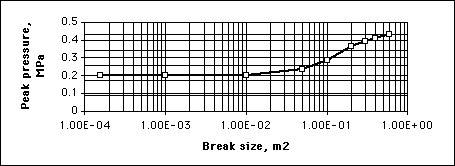
Results of calculations have shown that the maximum accidental pressure does not exceed the design limit 500 kPa even at maximum break 0.6 m2. In Figure 1 the peak in-vessel pressure as function of break size is shown. Developed MELCOR models with some modifications, were used for estimation of possible environmental releases in case of a confinement boundaries failure.