S. J. Piet, P. Bosia, E. DiPietro, D. A. Dilling, G. Johnson, Y. Kataoka, M. I. Makowski, R. Schleicher, M. Sironi, C. Walker, M. Wykes
ITER Joint Central Team
The ITER confinement is tailored to meet the consensus environmental release limits adopted by the project. This paper summarizes the ITER confinement functional requirements, describes the confinement strategy for the ITER tokamak, and shows how the design meets the project objectives.
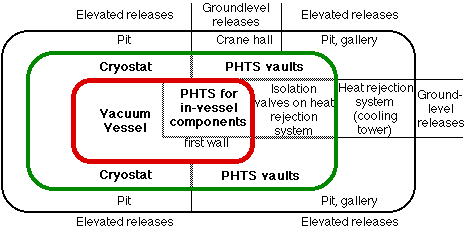
All tokamak radioactive source terms are confined by two barriers, starting with the 1st barrier vacuum vessel (VV) and 2nd barrier cryostat vessel (CV). Thus, two critical components are high quality vacuum vessels (VV and CV), which must be intact for the machine to operate. The first barrier with respect to the heat transport system (HTS) is the primary HTS itself. The second HTS confinement barrier is the PHTS vaults, CV, HTS guardpipes outside the CV, NBI cell, and isolation valves in the heat rejection system. Features to prevent or limit releases via other penetrations of the VV are tailored to the characteristics of the potential hazards associated with each system, as in a chemical plant. This strategy includes first and second barriers in various heating and current drive systems interfacing with the plasma.
Outside the second barrier, some volumes have confinement-related functions such as heating, ventilation, and air conditioning (HVAC). All volumes in the pit and gallery portions of the tokamak building have HVAC and thus any environmental releases are elevated (stacked). Some of these volumes also have filters or dryers to capture aerosols or tritiated water vapor if the hazard relating to equipment in the volume warrants this additional protection. Most penetrations from the VV terminate in the pit, gallery, or tritium building.